
Адаптація методу оцінки зваженої ефективності фотоелектричних інверторів до кліматичних та експлуатаційних умов України
Анотація
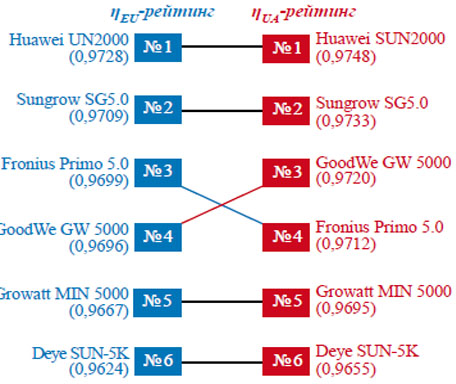
Розроблено методику визначення регіональних зважених коефіцієнтів ефективності фотоелектричних інверторів на основі даних PVGIS SARAH-3 (2005–2023). Методику застосовано для 19 локацій України, що охоплюють п’ять кліматичних зон. Запропоновано та розраховано національний зважений коефіцієнт корисної дії (ККД) та проведено порівняння з європейським та каліфорнійським зваженими ККД. Встановлено, що розподіл робочих точок інверторів в Україні суттєво відрізняється від закладеного в європейському стандарті оцінки ефективності інверторів. Зокрема, вага домінантної точки навантаження суттєво знижується порівняно з європейською метрикою, а вага точки повного навантаження стає практично нульовою. На практиці це призводить до зміни рейтингу комерційних інверторів та має важливе значення для проєктування фотоелектричних систем в Україні.
Ключові слова: фотоелектричний інвертор, зважена ефективність, коефіцієнт корисної дії, національний зважений ККД, PVGIS, європейська ефективність, каліфорнійська ефективність.
Посилання
IEA, Empowering Ukraine Through a Decentralised Electricity System, Paris, France: IEA, 2024. [Online]. Available: https://www.iea.org/reports/empowering-ukraine-through-a-decentralised-electricity-system
C. Winkler et al., “High-Resolution rooftop photovoltaic potential assessment for a resilient energy system in Ukraine,” Energy Conversion and Management: X, vol. 28, p. 101242, 2025. https://doi.org/10.1016/j.ecmx.2025.101242.
Overall efficiency of grid connected photovoltaic inverters, EN 50530:2010+A1:2013, CENELEC, 2013. [Online]. Available: https://standards.iteh.ai/catalog/standards/clc/ca163ee5-96cc-4cd4-8be5-10dca018f9e4/en-50530-2010-a1-2013?srsltid=AfmBOoq36RFnyRA1Eibax0nOXFGCLpsPsLoqPiPx4ml0e2yKkWvkWlSZ
M. Jantsch, H. Schmidt, and J. Schmid, “Results of the concerted action on power conditioning and control,” in Proceedings of the 11th European Photovoltaic Solar Energy Conference, Montreux, Switzerland, 1993, pp. 1589–1593. [Online]. Available: https://www.tib.eu/en/search/id/BLCP:CN002262241/Results-of-the-Concerted-Action-on-Power-Conditioning?cHash=da43bae4c279d164f233788118ef5d4e
S. Gonzalez, J. Newmiller, and D. Blodgett, Performance Test Protocol for Evaluating Inverters Used in Grid-Connected Photovoltaic Systems, Sandia National Laboratories, Albuquerque, NM, USA, Tech. Rep. SAND-2015-1817R, 2015. https://doi.org/10.2172/1177757.
G. A. Rampinelli, A. Krenzinger, and F. Chenlo Romero, “Mathematical models for efficiency of inverters used in grid connected photovoltaic systems,” Renewable and Sustainable Energy Reviews, vol. 34, pp. 578–587, Jun. 2014. https://doi.org/10.1016/j.rser.2014.03.047.
D. L. King, S. Gonzalez, G. M. Galbraith, and W. E. Boyson, Performance Model for Grid-Connected Photovoltaic Inverters, Sandia National Laboratories, Albuquerque, NM, USA, Tech. Rep. SAND2007-5036, 2007. https://doi.org/10.2172/920449.
IEEE Recommended Practice for Testing the Performance of Stand-Alone Photovoltaic Systems, IEEE Standard 1526-2020, 2020. https://doi.org/10.1109/IEEESTD.2020.9142279.
A. Driesse, P. Jain, and S. Harrison, “Beyond the curves: Modeling the electrical efficiency of PV inverters,” in Proceedings of the 33rd IEEE Photovoltaic Specialists Conference (PVSC), San Diego, CA, USA, 2008, pp. 1–6. https://doi.org/10.1109/PVSC.2008.4922827.
I. Ongun and E. Ozdemir, “Weighted efficiency measurement of PV inverters: Introducing η_IZMIR,” Journal of Optoelectronics and Advanced Materials, vol. 15, no. 5-6, pp. 550–554, Jun. 2013. [Online]. Available: https://joam.inoe.ro/articles/weighted-efficiency-measurement-of-pv-inverters-introducing-izmir/fulltext
A. A. Rahman, Z. Salam, S. Shaari, and M. Z. Ramli, “Methodology to Determine Photovoltaic Inverter Conversion Efficiency for the Equatorial Region,” Applied Sciences, vol. 10, no. 1, p. 201, Jan. 2020. https://doi.org/10.3390/app10010201.
B. Nasir, “Efficiency Assessment of an Inverter based on Solar PV Energy in Baghdad,” Engineering, Technology & Applied Science Research, vol. 14, no. 2, pp. 13425–13429, Apr. 2024. https://doi.org/10.48084/etasr.6948.
A. Byamungu, “The formulation and validation of PV inverter efficiency under South Africa climate conditions,” M.Tech. thesis, Dept. Elect., Electron. Comput. Eng., Cape Peninsula Univ. Technol., Cape Town, South Africa, 2019. [Online]. Available: https://etd.cput.ac.za/handle/20.500.11838/2823
A. Kalathil and H. Krishnamurthy, “Quantification of solar inverter efficiency for Indian tropical climatic conditions,” in Proceedings of the IEEE Region 10 Humanitarian Technology Conference (R10-HTC), Chennai, India, 2014, pp. 108–113. https://doi.org/10.1109/R10-HTC.2014.7026316.
A. Harish et al., “Formulation of Efficiency of Inverters for Solar Photovoltaic Power Plants — Indian Case Study,” in Proceedings of the IEEE International Conference on Power Electronics, Control and Automation (PEEIC), Greater Noida, India, 2019, pp. 1–6. https://doi.org/10.1109/PEEIC47157.2019.8976638.
F. H. Dupont, C. Rech, and J. R. Pinheiro, “A methodology to obtain the equations for the calculation of the weighted average efficiency applied to photovoltaic systems,” in Proceedings of the 10th IEEE/IAS International Conference on Industry Applications (INDUSCON), Fortaleza, Brazil, 2012, pp. 1–8. https://doi.org/10.1109/INDUSCON.2012.6453445.
B. Burger and R. Ruther, “Inverter sizing of grid-connected photovoltaic systems in the light of local solar resource distribution characteristics and temperature,” Solar Energy, vol. 80, no. 1, pp. 32–45, Jan. 2006. https://doi.org/10.1016/j.solener.2005.08.012.
O. O. Shaviolkin, “Structures of single-phase converter units for combined power supply systems with photovoltaic solar batteries,” Technical Electrodynamics, no. 2, pp. 39–46, Mar./Apr. 2018 (in Ukrainian). https://doi.org/10.15407/techned2018.02.039.
O. O. Shaviolkin and I. O. Shvedchykova, “Multifunctional converter for single-phase combined power supply systems of local objects with photovoltaic solar batteries,” Technical Electrodynamics, no. 5, pp. 92–100, Sep./Oct. 2018 (in Ukrainian). https://doi.org/10.15407/techned2018.05.092.
I. V. Blinov, I. V. Trach, Ye. V. Parus, D. H. Derevianko, and V. M. Khomenko, “Voltage and reactive power regulation in distribution electrical networks using dispersed renewable energy sources,” Technical Electrodynamics, no. 2, pp. 60–68, Mar./Apr. 2022 (in Ukrainian). https://doi.org/10.15407/techned2022.02.060.
O. V. Kulapin et al., “Impact of generation and load seasonality on the optimal capacity of a prosumer microgrid energy storage system,” Technical Electrodynamics, no. 3, pp. 73–82, May/Jun. 2025 (in Ukrainian). https://doi.org/10.15407/techned2025.03.073.
A. V. Ivanchenko, S. V. Mazuryk, and A. S. Tonkoshkur, “Study of the characteristics of silicon photovoltaic converters of solar batteries during overheating,” Technology and Design in Electronic Equipment, no. 4, pp. 14–20, 2018 (in Ukrainian). https://doi.org/10.15222/TKEA2018.4.14.
A. V. Ivanchenko and A. S. Tonkoshkur, “Changes in the characteristics of silicon photovoltaic elements of solar batteries after current overloads,” Technology and Design in Electronic Equipment, no. 3-4, pp. 19–25, 2019 (in Ukrainian). https://doi.org/10.15222/TKEA2019.3-4.19.
A. O. Yefimenko and L. I. Prysyazhnyuk, “Models and algorithms for optimizing solar battery placement,” Technology and Design in Electronic Equipment, no. 3-4, pp. 24–34, 2023 (in Ukrainian). https://doi.org/10.15222/TKEA2023.3-4.24.
O. F. Bondarenko, T. O. Ryzhakova, and Yu. V. Kozhushko, “Improved method for estimating power losses in switching converters of microcontact welding machines,” Technology and Design in Electronic Equipment, no. 3, pp. 38–42, 2018 (in Ukrainian). https://doi.org/10.15222/TKEA2018.3.38.
T. Yakushkin, R. Yershov, and S. Stepenko, “Comparative analysis of topologies and algorithms for maximum power point trackers in photovoltaic systems,” Technical Sciences and Technologies, no. 2 (32), pp. 321–339, 2023 (in Ukrainian). https://doi.org/10.25140/2411-5363-2023-2(32)-321-339.
O. Hlushko et al., “Review of top energy innovators influencing the development of renewable energy,” Technical Sciences and Technologies, no. 1 (35), pp. 274–284, 2024 (in Ukrainian). https://doi.org/10.25140/2411-5363-2024-1(35)-274-284.
D. Zakharchenko and S. Stepenko, “Review and justification of the choice of electrical energy storage systems for energy facilities operation,” Technical Sciences and Technologies, no. 4 (22), pp. 198–209, 2020 (in Ukrainian). https://doi.org/10.25140/2411-5363-2020-4(22)-198-209.
A. Fesenko, O. Gusev, A. Chub, D. Vinnikov, and O. Matyushkin, “Review of weight, size, and cost parameters of commercial solar inverters,” Technical Sciences and Technologies, no. 4 (14), pp. 183–193, 2018 (in Ukrainian). https://doi.org/10.25140/2411-5363-2018-4(14)-183-193.
O. Hlushko and S. Stepenko, “Parameters, characteristics, and factors influencing the efficiency and reliability of photovoltaic converters operating within power systems,” Technical Sciences and Technologies, no. 1 (23), pp. 249–264, 2021 (in Ukrainian). https://doi.org/10.25140/2411-5363-2021-1(23)-249-264.
K. Reva and S. Stepenko, “Study of characteristics of elements of autonomous power supply systems based on photovoltaic converters,” Technical Sciences and Technologies, no. 2 (8), pp. 162–171, 2017 (in Ukrainian). [Online]. Available: https://tst.stu.cn.ua/article/view/113126
O. Savchenko et al., “SolarM2P: map-to-point deep neural network for post-processing of numerical weather prediction-based solar irradiance forecasts,” Przegląd Elektrotechniczny, vol. 101, no. 4, 2025. https://doi.org/10.15199/48.2025.04.09.
R. Kosenko, S. Stepenko, and O. Veligorskyi, “High-efficiency solar tracker development and effectiveness estimation,” in Proceedings of the International Conference on Intelligent Energy and Power Systems (IEPS), Kyiv, Ukraine, 2014, pp. 153–158. https://doi.org/10.1109/IEPS.2014.6874169.
S. Stepenko et al., “Experimental Evaluation of the Battery-Assisted 2kW Inverter Efficiency Indicators,” in Proceedings of the 19th Biennial Baltic Electronics Conference (BEC), Tallinn, Estonia, 2024. https://doi.org/10.1109/BEC61458.2024.10737971.
S. Stepenko et al., “Experimental Comparison of Two-Level Full-SiC and Three-Level Si-SiC Quasi-Z-Source Inverters for PV Applications,” Energies, vol. 12, no. 13, p. 2509, Jul. 2019. https://doi.org/10.3390/en12132509.
S. Stepenko et al., “Physical Modeling and Analysis of Gate Drive DC-DC Converter Impact on Photovoltaic Inverter Efficiency,” in Model-Based Design and Simulation in Industry 4.0. MODS 2022, (Lecture Notes in Networks and Systems, vol. 667), Cham, Switzerland: Springer, 2023, pp. 261–270. https://doi.org/10.1007/978-3-031-30251-0_20.
A. Chub, D. Vinnikov, S. Stepenko, E. Liivik, and F. Blaabjerg, “Photovoltaic Energy Yield Improvement in Two-Stage Solar Microinverters,” Energies, vol. 12, no. 19, p. 3774, Oct. 2019. https://doi.org/10.3390/en12193774.
PVGIS v5.3, European Commission Joint Research Centre, Seville, Spain. [Online]. Available: JRC PVGIS
T. Huld and A. M. Gracia Amillo, “Estimating PV Module Performance over Large Geographical Regions: The Role of Irradiance, Air Temperature, Wind Speed and Solar Spectrum,” Energies, vol. 8, no. 6, pp. 5159–5181, Jun. 2015. https://doi.org/10.3390/en8065159.
D. Faiman, “Assessing the outdoor operating temperature of PV modules,” Progress in Photovoltaics: Research and Applications, vol. 16, no. 4, pp. 307–315, Jun. 2008. https://doi.org/10.1002/pip.813.
Terrestrial photovoltaic (PV) modules — Design qualification and type approval, IEC Standard 61215:2021, International Electrotechnical Commission, 2021.
Installed electrical capacity of "green" energy producers (based on data from NEURC and State Energy Efficiency), Energy Map, DiXi Group (in Ukrainian). [Online]. Available: : https://energy-map.info/uk/resources/699855af-945a-477a-93e7-d479b56f8e2c/
Photovoltaic systems — Power conditioners — Procedure for measuring efficiency, IEC Standard 61683:1999, International Electrotechnical Commission, 1999.
H. Karpchuk, V. Budko, and O. Lysenko, “Technical achievable potential of photovoltaic conversion of solar radiation for the conditions of Ukraine,” EPJ Photovoltaics, vol. 15, art. 30, Oct. 2024. https://doi.org/10.1051/epjpv/2024016.
Global Solar Atlas 2.0, World Bank Group, Washington, DC, USA. [Online]. Available: https://globalsolaratlas.info/
S. O. Kudrya (ed.), Atlas of Renewable Energy Potential of Ukraine, Kyiv, Ukraine: Institute of Renewable Energy of the National Academy of Sciences of Ukraine, 2020 (in Ukrainian).
I. Redko et al., “Estimation of the energy potential of solar radiation and comparison with normative data for Ukraine,” Meteorology Hydrology and Water Management, vol. 13, no. 1, pp. 60–73, 2025. https://doi.org/10.26491/mhwm/208954.
State and development prospects of solar energy in Ukraine, ASEU (Association of Solar Energy of Ukraine) (in Ukrainian). [Online]. Available: https://www.aseu.solar/en/about-6
Electricity outages lasted 2,000 hours for Ukrainian households in 2024, DiXi Group. [Online]. Available: https://dixigroup.org/en/electricity-outages-lasted-2-thousand-hours-for-ukrainian-households-in-2024/
Авторське право (c) 2026 Ігор Твердовський, Сергій Степенко

Ця робота ліцензується відповідно до Creative Commons Attribution 4.0 International License.