
Mathematical modeling of current density distribution in electrodes of electrosurgical instruments with rectangular working surfaces
Abstract
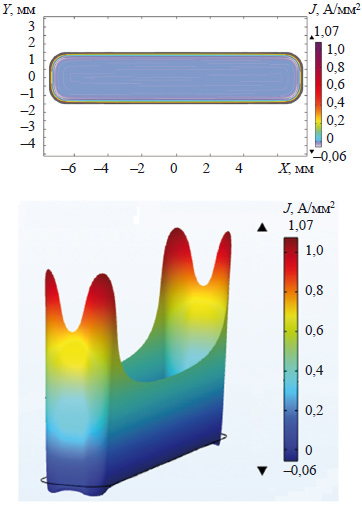
This study investigates the influence of the skin effect on electromagnetic processes occurring in the rectangular electrodes of electrosurgical instruments during alternating current flow. The mathematical modeling was performed by solving partial differential equations using the numerical finite element method. The simulation results demonstrate an uneven current density distribution along the perimeter of the rectangular electrode. The current is highly concentrated in the corners of the electrode and is practically absent in its center. The active resistance of a copper rectangular electrode (with a cross-section of 3 х 15 mm and a length 3 mm) was analyzed within the frequency range of 22 to 880 kHz. It was established that increasing the current frequency leads to higher joule heating losses in the electrodes due to a reduction in the effective cross-sectional area caused by the skin effect. Modifying the electrode geometry by rounding its corners allows for equalizing the current density distribution and reducing the total resistance.
References
V. M. Sydorets and A. G. Dubko, “Current distribution in the electrodes of electrosurgical instruments during welding of biological tissues (in Ukrainian),” East Eur. J. Adv. Technol., no. 3, pp. 24–28, 2015. https://doi.org/10.15587/1729-4061.2015.43372.
J. A. Pearce, “FEM numerical model study of electrosurgical dispersive electrode design parameters,” in Proc. 37th Annu. Int. Conf. IEEE Eng. Med. Biol. Soc. (EMBC), 2015, pp. 2559–2562. https://doi.org/10.1109/EMBC.2015.7318914.
N. H. Nessler and W. Reischer, “Mesuring device for neutral electrodes in electrosurgery,” Measurement, vol. 33, no. 2, pp. 197–203, 2003. https://doi.org/10.1016/S0263-2241(02)00063-5.
D. Messenger, F. Carter, E. Noble, and N. Francis, “Electrosurgery and energized dissection,” Surgery (Oxford), vol. 38, no. 3, pp. 133–138, 2020. https://doi.org/10.1016/j.mpsur.2020.01.006.
M. Zareba, T. Szczegielniak, and P. Jabłonski, “Influence of the Skin and Proximity Effects on the Thermal Field in a System of Two Parallel Round Conductors,” Energies, vol. 16, no. 17, art. no. 6341, pp. 1–20, 2023. https://doi.org/10.3390/en16176341.
V. T. Morgan, “The current distribution, resistance and internal inductance of linear power system conductors—A review of explicit equations,” IEEE Trans. Power Deliv., vol. 28, no. 3, pp. 1252–1262, Jul. 2013. https://doi.org/10.1109/TPWRD.2013.2250314.
O. N. Voitsekhovskyi, N. L. Don, and O. O. Demchenko, “Investigation of the surface effect and proximity effect of a two-wire line,” Bull. KhNTU (in Ukrainian), no. 4 (67), pp. 31–35, 2018. Available: http://nbuv.gov.ua/UJRN/Vkhntu_2018_4_7.
J. R. Gonzalez-Teodoro, V. Kindl, E. Romero-Cadaval, and R. Asensi, “Analysis of Skin Effect in Single Wire Resistance by Finite Element Methods,” in Proc. IEEE 14th Int. Conf. Compatibility, Power Electron. Power Eng. (CPE-POWERENG), 2020, pp. 19–23. https://doi.org/10.1109/CPE-POWERENG48600.2020.9161540.
B. Tabei, A. M. Gole, and B. Kordi, “Skin and Proximity Effect Calculation of a System of Rectangular Conductors Using the Proper Generalized Decomposition Technique,” Energies, vol. 17, no. 12, art. no. 2828, pp. 1–22, 2024. https://doi.org/10.3390/en17122828.
O. P. Yanenko, S. M. Peregudov, and K. L. Shevchenko, Radiometric Microwave Methods and Means of Measuring Physical Quantities (in Ukrainian). Kyiv, Ukraine: Igor Sikorsky Kyiv Polytechnic Institute, 2021. Available: https://ela.kpi.ua/handle/123456789/41470.
G. S. Marinsky et al., “High-frequency equipment for welding living tissues (Review) (in Ukrainian),” Autom. Welding, no. 1, pp. 29–37, 2023. https://doi.org/10.37434/as2023.01.05.
O. Linchevskyy, A. Makarov, and V. Getman, “Lung sealing using the tissue-welding technology in spontaneous pneumothorax,” Eur. J. Cardiothorac. Surg., vol. 37, no. 5, pp. 1126–1128, 2010.
N. Umanets, N. V. Pasyechnikova, V. A. Naumenko, P. B. Henrich, and A. Cuschieri, “High-frequency electric welding: A novel method for improved immediate chorioretinal adhesion in vitreoretinal surgery,” Graefe's Arch. Clin. Exp. Ophthalmol., vol. 252, no. 10, pp. 1697–1703, 2014.
V. Y. Molotkovets et al., “Restoration of the Integrity of a Transected Peripheral Nerve with the Use of an Electric Welding Technology,” Neurophysiology, vol. 52, no. 1, pp. 31–42, 2020.
M. Y. Bolgov et al., Atlas of Ligature-Free Operations on the Thyroid Gland (in Ukrainian). Kyiv, Ukraine: KIM, 2024.
S. V. Tkachenko, O. V. Romanenko, N. A. Chvertko, and A. G. Dubko, “Current state and prospects for development in welding of biological tissues,” in Welding and Related Technologies: Proceedings of the VIIth International Conference on Welding and Related Technologies (WRT 2024), I. Krivtsun et al., Eds. London, UK: CRC Press, 2025, pp. 143–148. https://doi.org/10.1201/9781003518518143-148.
B. E. Paton and O. N. Ivanova, Tissue-Protecting High-Frequency Electric Welding Surgery (in Russian). Kyiv, Ukraine: Naukova Dumka, 2009.
V. O. Moskalyuk and T. A. Saurova, Field Theory (in Ukrainian). Kyiv, Ukraine: Igor Sikorsky Kyiv Polytechnic Institute, 2018.
Z. Popovic and B. Popovic, Introductory Engineering Electromagnetics. Upper Saddle River, NJ, USA: Prentice Hall, 1999.
Copyright (c) 2026 Andriі Dubko, Oleksandr Romanenko, Serhii Rymar

This work is licensed under a Creative Commons Attribution 4.0 International License.