
Neural network-based methods for spread spectrum signal classification in radio monitoring systems
Abstract
Automatic classification of spread spectrum signals — frequency-hopping, direct-sequence, and chirp — is a key task in modern radio monitoring systems, particularly relevant for distributed sensor networks with constrained computational resources. A critical review of existing approaches shows that none of the three generations of classification methods — classical deterministic, feature-based machine learning, and deep learning on time-frequency representations — simultaneously meets three essential requirements: high accuracy at negative signal-to-noise ratios, computational complexity below 105 multiply–accumulate operations per realization, and compatibility with integer arithmetic for embedded deployment. This paper proposes a method that addresses this gap through
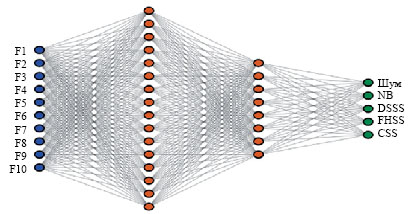
a compact, informative feature vector combining frequency-domain, time-frequency, and statistical characteristics. The informativeness of Hjorth parameters is theoretically justified via their analytical link to spectral moments of the power spectral density, enabling O(N) time-domain computation equivalent to frequency-domain analysis. A formalized ablation analysis with three quantitative selection criteria (individual significance, pairwise correlation below 0.7, and absence of negative contribution) yields a reduced vector of five components. Complexity analysis confirms approximately 3·104 operations per realization and 2 kB model memory in integer configuration — four orders of magnitude less than convolutional network–based approaches. Experimental evaluation of a multilayer perceptron classifier demonstrates stable accuracy above 91% across a wide SNR range, 93.2% at 20 dB and 87% at −10 dB, with negligible degradation under integer quantization, confirming practical applicability to embedded and distributed radio monitoring systems.
References
D. Torrieri, Principles of Spread-Spectrum Communication Systems, 5th ed. Cham, Switzerland: Springer, 2022, 710 p. https://doi.org/10.1007/978-3-030-75343-6
D. Stanescu, A. Digulescu, C. Ioana, and A. Serbanescu, “Spread spectrum modulation recognition based on phase diagram entropy,” Frontiers in Signal Processing, vol. 3, art. no. 1197619, 2023. https://doi.org/10.3389/frsip.2023.1197619
N. Islam and S. Shin, “Deep learning in physical layer: review on data driven end-to-end communication systems and their enabling semantic applications,” IEEE Open Journal of the Communications Society, vol. 5, pp. 4207–4240, 2024. https://doi.org/10.1109/ojcoms.2024.3425314
I. V. Horbatyi and O. A. Usatyi, “ Comparative analysis of digital modulation classification methods based on deep neural networks (in Ukrainian),” Technology and Design in Electronic Equipment, no. 3 – 4, pp. 33 – 39, 2025. https://doi.org/10.15222/TKEA2025.3-4.33
C. M. Akujuobi, Wavelets and Wavelet Transform Systems and Their Applications: A Digital Signal Processing Approach. Cham, Switzerland: Springer, 2022, 644 p. https://doi.org/10.1007/978-3-030-87528-2
I. V. Horbatyi and O. A. Usatyi, “ Investigation of spread spectrum signal analysis methods in modern communication systems (in Ukrainian),” Information and Communication Technologies and Electronic Engineering, vol. 5, no. 1, pp. 125–135, 2025. https://doi.org/10.23939/ictee2025.01.125
M. T. Khan, A. Z. Sha’ameri, and M. M. A. Zabidi, “Classification of FHSS signals in a multi-signal environment by artificial neural network,” International Journal of Computing and Digital Systems, vol. 11, no. 1, pp. 775 – 789, 2022. https://doi.org/10.12785/ijcds/110163
T. Huynh-The, V.-S. Doan, C.-H. Hua, Q.-V. Pham, T.-V. Nguyen, and D.-S. Kim, “Accurate LPI radar waveform recognition with CWD-TFA for deep convolutional network,” IEEE Wireless Communications Letters, vol. 10, no. 8, pp. 1638–1642, 2021. https://doi.org/10.1109/LWC.2021.3075880
B. Jacob et al., “Quantization and training of neural networks for efficient integer-arithmetic-only inference,” in Proc. IEEE Conf. Computer Vision and Pattern Recognition (CVPR), Salt Lake City, USA, 2018, pp. 2704 – 2713. https://doi.org/10.1109/CVPR.2018.00286
H. Zhao, D. Liu, and H. Li, “Efficient integer-arithmetic-only convolutional neural networks,” arXiv preprint, arXiv:2006.11735, 2020. [Online]. Available: https://arxiv.org/abs/2006.11735
A. Gholami, S. Kim, Z. Dong, Z. Yao, M. W. Mahoney, and K. Keutzer, “A survey of quantization methods for efficient neural network inference,” in Low-Power Computer Vision. Boca Raton, FL, USA: CRC Press, 2022, pp. 291 – 326. https://doi.org/10.1201/9781003162810-13
B. Hjorth, “EEG analysis based on time domain properties,” Electroencephalography and Clinical Neurophysiology, vol. 29, no. 3, pp. 306–310, 1970. https://doi.org/10.1016/0013-4694(70)90143-4
W. H. Alawee, A. Basem, and L. A. Al-Haddad, “Advancing biomedical engineering: Leveraging Hjorth features for electroencephalography signal analysis,” Journal of Electrical Bioimpedance, vol. 14, no. 1, pp. 66–72, 2023. https://doi.org/10.2478/joeb-2023-0009
M. A. Richards, Fundamentals of Radar Signal Processing, 2nd ed. New York, NY, USA: McGraw-Hill, 2014, 656 p.
V. Maksimov and I. Khrapovitsky, “New composite Barker codes in the synchronization system of broadband signals,” Information and Telecommunication Sciences, no. 2, pp. 24–30, 2020. https://doi.org/10.20535/2411-2976.22020.24-30
Copyright (c) 2026 Ivan Horbatyi, Oleksandr Usatyi

This work is licensed under a Creative Commons Attribution 4.0 International License.