
Characteristics of nanocluster subsystem components of heterojunctions
Abstract
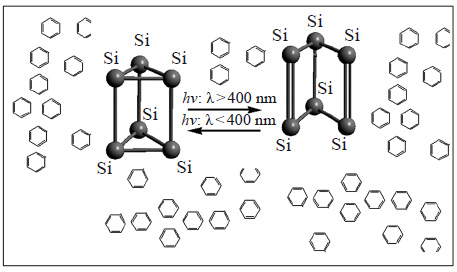
A calculation and analysis of the characteristics of nanocluster (NC) subsystem components as structural elements for silicon electronics materials have been performed. Effective computational models were selected to evaluate the structural, energetic, and kinetic characteristics of NCs of various sizes. To analyze geometric topology stability and electron density distribution, a physical model based on quantum-chemical methods and interatomic interaction potentials is proposed. Atomic structure optimization and electronic property analysis of silicon nanostructures revealed that chemical bond lengths increase during cationization and decrease during anionization. The influence of the matrix environment on nanocluster properties was analyzed. A phenomenon defined as the “switching” of interatomic chemical bonds within the nanocluster was identified. This effect yields practical optical capabilities that can be utilized to design color-sensitive semiconductor devices.
References
Yu. M. Poplavko, Solid State Physics (in Ukrainian), vol. 1, Structure, Quasiparticles, Metals, Magnetics. Kyiv, Ukraine: Igor Sikorsky Kyiv Polytechnic Institute, Publishing House “Polytechnica”, 2017.
K. Jackson and J. Jellinek, “Si clusters are more metallic than bulk Si,” J. Chem. Phys., vol. 145, no. 24, p. 244302, 2016, https://doi.org/10.1063/1.4972813.
S. Manna, Y. Wang, A. Hernandez et al., “A database of low-energy atomically precise nanoclusters,” Sci. Data, vol. 10, pp. 308 – 311, 2023, https://doi.org/10.1038/s41597-023-02200-4.
V. V. Kovalchuk, D. O. Dyachok, D. O. Korchevskyi, and D. O. Popriaha, “Methods of forming the matrix environment of nanoclusters in the case of biological objects” (in Ukrainian), Acta Carpathica, vol. 44, no. 2, pp. 106 – 114, 2025, https://doi.org/10.32782/2450-8640.2025.2.11.
V. V. Kovalchuk, D. O. Dyachok, and D. O. Popriaha, “Film heterojunction with nanocluster subsystem for new type of photocells,” Technology and design in electronic equipment, no. 3, pp. 9 – 14, 2025, https://doi.org/10.15222/TKEA2025.3-4.09.
V. V. Kovalchuk and D. O. Popriaha, “Formation of a nanocluster subsystem of a film heterotransfer,” (in Ukrainian) Sensor Electron. Microsyst. Technol., vol. 23, no. 3, pp. 58 – 64, 2025, https://doi.org/10.18524/1815-7459.2025.3.339805.
O. H. Pashynska and A. V. Zavdoveev, “Artificial intelligence in materials science: Changes in discovery and development of materials” (in Ukrainian), Sci. J. Metinvest Polytech. Ser. Tech. Sci., no. 5, pp. 152 – 163, 2025, https://doi.org/10.32782/3041-2080/2025-5-17.
M. Uchida, T. Yokoi, Y. Ogura, and K. Matsunaga, “Artificial-neural-network descriptor enhancing accuracy of machine-learning interatomic potential and its application to lattice defects in Si,” Phys. Rev. Mater., vol. 10, no. 8, p. 103805, 2024, https://doi.org/10.1103/PhysRevMaterials.8.103805.
W.-H. Yang, W.-C. Lu, C. Z. Wang, and K. M. Ho, “How big does a Si nanocluster favor bulk bonding geometry?,” J. Phys. Chem. C, vol. 120, no. 3, pp. 1966 – 1970, 2016, https://doi.org/10.1021/acs.jpcc.5b11004.
N. E. Mohammad, “Comparing empirical interatomic potentials to modeling silicon surface stress,” Solid State Commun., vol. 344, p. 114656, 2022, https://doi.org/10.1016/j.ssc.2022.114656.
M. Uchida, T. Yokoi, Y. Ogura, and K. Matsunaga, “Application of neural-network potential based on trainable descriptor to crystallographically complex lattice defects in silicon,” Phys. Rev. Mater., vol. 9, p. 113804, 2025, https://doi.org/10.1103/3gx6-zp38.
N. Pangeni, C. Shahi, J. Perdew, V. Subramanian, B. Kanungo, V. Gavini, and A. Ruzsinszky, “Hartree-Fock density functional theory works through error cancellation for the interaction energies of halogen and chalcogen bonded complexes,” J. Chem. Phys., vol. 9, pp. 3 – 11, 2025, https://doi.org/10.26434/chemrxiv-2025-wfft9-v2.
V. V. Kovalchuk, “Optical properties of clusters,” J. Phys. Electron., vol. 26, no. 1, pp. 29 – 34, 2018, https://doi.org/10.15421/331804.
A. Sekiguchi and H. Sakurai, “Exotic polyhedral oligogermanes and related molecules,” in The Chemistry of Inorganic Ring Systems, R. Steudel, Ed. New York, NY, USA: Elsevier, 1992, pp. 101 – 123.
V. V. Kovalchuk and M. O. Yakovenko, “A systematic analysis of calculation schemes in quantum chemical bonding theory using the GAMESS platform,” in Proc. IX Int. Sci. Pract. Conf. Ricerche Scientifiche e Metodi della Loro Realizzazione: Esperienza Mondiale e Realtà Domestiche, Bologna, Italy, July 10, 2026, pp. 78 – 82, [Online]. Available: https://archive.logos-science.com/index.php/conference-proceedings/article/view/3771.
S. Ali and E. Neyts, “Size-dependent strain and surface energies of gold nanoclusters,” Phys. Chem. Chem. Phys., vol. 18, no. 2, pp. 792 – 800, 2016, https://doi.org/10.1039/C5CP06153A.
Copyright (c) 2026 Volodymyr Kovalchuk, Dmitry Korban, Maxim Yakovenko

This work is licensed under a Creative Commons Attribution 4.0 International License.