
Topological transformation of eddy currents in anisotropic electrically conductive structures
Abstract
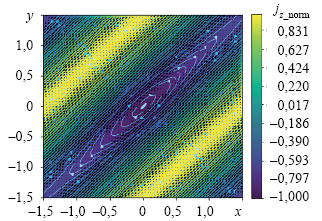
This paper presents numerical modeling and a comprehensive topological analysis of the eddy current density component jz distribution in homogeneous anisotropic electrically conductive plates. The analysis is performed using a spectral-domain solver based on the Fourier transform of the Poisson equation and covers a wide range of anisotropy coefficients (0.05 ≤ K ≤ 150) at a crystallographic axis orientation angle γ = 45°. The results demonstrate that the classical interpretation of eddy current structure 'destruction' at extreme K values is actually a qualitative topological transformation—specifically, a transition from closed elliptical trajectories to quasi-linear directed flows. We prove the invariance of this transformation mechanism with respect to the reciprocal transformation K → 1/K accompanied by a 90° coordinate system rotation. Furthermore, by analyzing the curvature radius of eddy current lines at the ellipse vertices, we propose a physically justified criterion for determining critical operating regimes. This criterion directly links the plate's geometric parameters (thickness dlayer, major and minor semi-axes l and m) to the critical anisotropy coefficient Kcr. Practically, these findings allow for deliberate control over the eddy current field topology in anisotropic electrically conductive transducers. Transitioning to the quasi-linear regime enables significant adjustments in device impedance, control of the transformation ratio and inductance, and the realization of directed energy flows. This opens up new avenues for developing efficient matching elements, directed electromagnetic radiation sources, antenna systems, and optimized wideband infocommunication devices with enhanced energy efficiency.
References
E. Chiodo, P. De Falco, and L. P. Di Noia, “Challenges and new trends in power electronic devices reliability,” Electronics (Basel), vol. 10, no. 8, p. 925, Apr. 2021, https://doi.org/10.3390/electronics10080925.
M. Odiamenhi, H. Jahanbakhsh Basherlou, C. Hwang See, N. Ojaroudi Parchin, K. Goh, and H. Yu, “Advancements and challenges in antenna design and rectifying circuits for radio frequency energy harvesting,” Sensors (Basel), vol. 24, no. 21, p. 6804, Oct. 23 2024, https://doi.org/10.3390/s24216804.
M. Derevianchuk, A. Ashcheulov, and D. Lavreniuk, “Phenomenon of electro-ohmic transformation [in Ukrainian],” Physics and Chemistry of Solid State, vol. 21, no. 4, pp. 743 – 748, Dec. 2020, https://doi.org/10.15330/pcss.21.4.743-748.
A. Ashcheulov, M. Derevianchuk, D. Lavreniuk, O. Verenko, and I. Romaniuk, “Anisotropic electro-ohmic transformer [in Ukrainian],” Metrology and Instruments, no. 5, pp. 27 – 32, 2020, https://doi.org/10.33955/2307-2180(5)2020.27-32.
A. Ashcheulov, M. Derevianchuk, D. Lavreniuk, and M. Rozhdestvenska, “Thermal losses of an anisotropic electrically conductive transformer,” Security of Infocommunication Systems and Internet of Things, vol. 3, no. 1, p. 01005, Jun. 2025, https://doi.org/10.31861/sisiot2025.1.01005.
A. Ashcheulov and M. Derevianchuk, “Distribution of vortex electric currents in an anisotropic electrically conductive transformer [in Ukrainian],” Technology and Design in Electronic Equipment, no. 3 – 4, pp. 3 – 8, 2025, https://doi.org/10.15222/TKEA2025.3-4.03.
M. Versaci, G. Angiulli, F. C. Morabito, and A. Palumbo, “A variational and multiplicative tensor framework for eddy current modeling in anisotropic composite materials with defects,” Mathematics, vol. 14, no. 7, p. 1141, 2026, https://doi.org/10.3390/math14071141.
Q. Yi, P. Wilcox, and R. Hughes, “Modelling and evaluation of carbon fibre composite structures using high-frequency eddy current imaging,” Composites Part B: Engineering, vol. 248, p. 110343, 2023, https://doi.org/10.1016/j.compositesb.2022.110343.
B. Pintér, A. Bingler, S. Bilicz, and J. Pávó, “Sensitivity analysis for the eddy current testing of carbon fiber reinforced plastic materials,” International Journal of Applied Electromagnetics and Mechanics, vol. 74, no. 4, pp. 397 – 403, 2024, https://doi.org/10.3233/JAE-230142.
J. F. Nye, Physical Properties of Crystals: Their Representation by Tensors and Matrices. Oxford, UK: Oxford Univ. Press, 1985.
L. I. Anatychuk, Thermoelectricity, Vol. 1: Physics of Thermoelectricity. Kyiv, Ukraine: Institute of Thermoelectricity, 1998.
L. N. Trefethen, Spectral Methods in MATLAB. Philadelphia, PA, USA: SIAM, 2000, https://doi.org/10.1137/1.9780898719598.
L. D. Landau and E. M. Lifshitz, Electrodynamics of Continuous Media. Oxford, UK: Butterworth-Heinemann, 1984.
P. Virtanen, R. Gommers, T. E. Oliphant, M. Haberland, T. Reddy, D. Cournapeau, et al.; SciPy 1.0 Contributors, “SciPy 1.0: Fundamental algorithms for scientific computing in Python,” Nature Methods, vol. 17, no. 3, pp. 261 – 272, Mar. 2020, https://doi.org/10.1038/s41592-019-0686-2.
C. R. Harris, K. J. Millman, S. J. van der Walt, R. Gommers, P. Virtanen, D. Cournapeau, et al., “Array programming with NumPy,” Nature, vol. 585, no. 7825, pp. 357 – 362, Sep. 2020, https://doi.org/10.1038/s41586-020-2649-2.
W. H. Press, S. A. Teukolsky, W. T. Vetterling, and B. P. Flannery, Numerical Recipes: The Art of Scientific Computing, 3rd ed. Cambridge, UK: Cambridge Univ. Press, 2007.
Copyright (c) 2026 Anatoly Ashcheulov, Mykola Derevianchuk

This work is licensed under a Creative Commons Attribution 4.0 International License.