
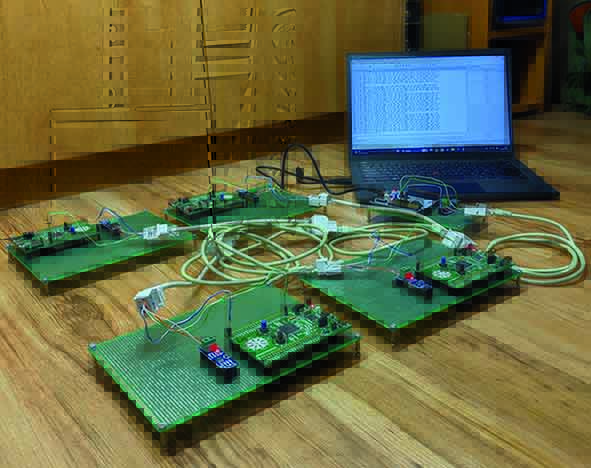
Hardware component of the system for monitoring the motion parameters of the mold oscillation mechanism
Abstract
The paper presents the development and experimental investigation of a multi-node measurement system for monitoring the oscillatory motion parameters of the mold in continuous casting machines. Ensuring stable oscillation program is crucial for slab solid shell formation, reduction of surface defects and prevention of surface breakout accidents. However, the known monitoring solutions based on discrete displacement or vibration sensors are often bulky, expensive, limited in the number of measurement points and difficult to integrate into existing equipment. The aim of the work is to increase the effectiveness of monitoring the mold oscillation mode by using compact MEMS inertial sensors integrated into a distributed microcontroller system with a robust industrial communication interface.
The proposed system includes four sensor nodes based on STM32F3 microcontrollers with built-in digital MEMS accelerometer and gyroscope and a central master module on STM32F0, interconnected via an RS-485 bus. Each sensor node performs synchronous acquisition of three-axis linear acceleration and angular rate at a sampling frequency of 100 Hz and transmits the measured data frames to the master, which aggregates them and forwards to a PC in CSV format for further analysis. The paper describes the hardware architecture of the nodes, the structure of the RS-485 communication protocol with synchronization frames and checksums, and the basic algorithms of firmware implementation.
Experimental tests on a laboratory stand confirmed stable operation of the developed system at 100 Hz with simultaneous data acquisition from four measurement points, sufficient bandwidth of the communication channel and correct reconstruction of inertial signals for typical oscillation modes.
The developed technical solutions can be used as the basis of an industrial complex for monitoring the oscillation of the mold of a continuous casting machine, in particular of a digital twin of the mold; for studying the oscillatory movements of mechanisms on other productions; as well as a training and research stand for delivering courses in measures and control systems.
References
C. Neef, S. Hirzel, and M. Arens, “Industry 4.0 in the European Iron and Steel Industry: Towards an Overview of Implementations and Perspectives,” Working document, Karlsruhe, Fraunhofer ISI, 2018, 26 p.
E. S. Szekeres, “Overview of mold oscillation in continuous casting,” Iron and Steel Engineer, Jul. 1996, pp. 29–37.
D. M. Lewis and J. Savage, “The Principles of Continuous Casting of Metals,” Metallurgical Reviews, vol. 1, part 1, 1956, pp. 65–116. https://doi.org/10.1179/mtlr.1956.1.1.65.
W. R. Irving, Continuous Casting of Steel, 1st ed. Boca Raton, FL, USA: CRC Press, 1994. doi: 10.1201/9781003575849.
J. Elfsberg, “Oscillation Mark Formation in Continuous Casting Processes,” Licentiate thesis, Royal Institute of Technology, Stockholm, Sweden, 2003, 53 p.
Q. Li, G. Wen, F. Chen, J. Zhang, Z. Liu, and H. Yin, “Irregular initial solidification by mold thermal monitoring in the continuous casting of steels: A review,” Int. J. Minerals Metallurgy and Materials, vol. 31, no. 5, 2024, pp. 1003–1015. https://doi.org/10.1007/s12613-023-2798-z.
Y. Nian, L. Zhang, C. Zhang, et al., “Application status and development trend of continuous casting reduction technology: A review,” Processes, vol. 10, no. 12, 2022, p. 2669. https://doi.org/10.3390/pr10122669.
V. O. Didenko, O. F. Bondarenko, and O. M. Polyeno, “The overview of tools for control of mold motion trajectory of continuous casting machine,” in Proc. Int. Sci.-Practical Conf. Modern Information and Electronic Technologies, vol. 1, Odesa, Ukraine, 2014, pp. 58–59. [Online]. Available: https://www.old.tkea.com.ua/siet/archive/2014-t1/058.pdf
V. O. Didenko, “Control of semiconductor converters in the electrohydraulic drive system by acceleration signals,” Ph.D. dissertation, Kyiv, Ukraine, 2017, 204 p.
W. A. Gill, I. Howard, I. Mazhar, and K. McKee, “A Review of MEMS Vibrating Gyroscopes and Their Reliability Issues in Harsh Environments,” Sensors, vol. 22, iss. 19, 2022, p. 7405. https://doi.org/10.3390/s22197405.
STMicroelectronics, “STM32 Nucleo-64 boards (MB1136),” User manual, Sep. 2025, 91 p. [Online]. Available: https://www.st.com/resource/en/user_manual/um1724-stm32-nucleo64-boards-mb1136-stmicroelectronics.pdf [Accessed: Nov. 25, 2025].
STMicroelectronics, “Discovery kit with STM32F303VC MCU,” User manual, Sep. 2023, 41 p. [Online]. Available: https://www.st.com/resource/en/user_manual/um1570-discovery-kit-with-stm32f303vc-mcu-stmicroelectronics.pdf [Accessed: Nov. 25, 2025].
STMicroelectronics, “LSM303DLHC: iNEMO inertial module: 3D accelerometer and 3D magnetometer,” Datasheet, Geneva, Nov. 2013, 52 p. [Online]. Available: https://www.st.com/resource/en/datasheet/lsm303dlhc.pdf [Accessed: Nov. 25, 2025].
STMicroelectronics, “L3GD20: MEMS motion sensor, three-axis digital output gyroscope,” Datasheet, Feb. 2014. [Online]. Available: https://www.st.com/resource/en/datasheet/l3gd20.pdf [Accessed: Nov. 25, 2025].
Copyright (c) 2025 Oleksii Lastovetskii, Oleksandr Yemets, Serhii Chuprykov, Oleksandr Bondarenko

This work is licensed under a Creative Commons Attribution 4.0 International License.