Comparative analysis of digital modulation classification methods based on deep neural networks
Abstract
Automatic classification of digital modulation formats (AMC) is a critical component of modern radio monitoring systems, cognitive communication platforms, and interference-resilient wireless communication systems. The rapid expansion of wideband and dynamically varying radio environments creates the need for classifiers that remain reliable across a broad range of signal-to-noise ratios (SNR). Recent advances in deep learning have significantly improved digital modulation classification performance, yet the impact of training strategies and neural-network architectures under low-SNR conditions remains insufficiently studied. This work addresses this gap by performing a comparative evaluation of two deep neural architectures — a 1D Convolutional Neural Network (CNN) and a complex-valued Residual Network — trained and tested on a large-scale dataset of digitally modulated I/Q signals.
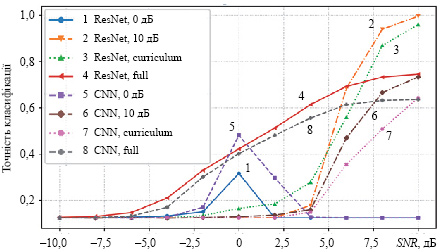
The research aimed to construct a mapping from raw time-domain I/Q sequences to discrete digital modulation labels while ensuring stability of the classifier with respect to SNR variations. Four training strategies are investigated: training at a single low SNR, training at a single high SNR, training over the full SNR range, and curriculum learning with gradually decreasing SNR. Both models are evaluated across the entire SNR interval using accuracy curves, Top-2 accuracy, and confusion matrices.
The experimental results demonstrate that the complex-valued Residual Network consistently outperforms the CNN, particularly in low-SNR scenarios, and benefits most from curriculum learning. The CNN provides competitive performance at moderate and high SNR but exhibits reduced robustness in noisy conditions. The findings highlight the practical relevance of selecting appropriate architectures and training schemes for reliable modulation classification in non-ideal radio environments. The presented framework enables reproducible benchmarking and can be applied to the design of noise-resilient AMC modules in real communication systems.
References
E. E. Azzouz, and A. K. Nandi, Automatic Modulation Recognition of Communication Signals. Boston, MA, USA: Springer, 1996, doi: 10.1007/978-1-4757-2469-1.
T. O’Shea, J. Corgan, and T. Clancy, “Convolutional Radio Modulation Recognition Networks,” arXiv preprint, arXiv:1602.04105, 2016. [Online]. Available: https://arxiv.org/abs/1602.04105
DeepSig Inc., “RadioML 2018.01A Dataset,” 2018. [Online]. Available: https://deepsig.ai/datasets. Accessed: Dec. 12, 2025.
S. Peng, S. Sun, and Y.-D. Yao, “A Survey of Modulation Classification Using Deep Learning: Signal Representation and Data Preprocessing,” IEEE Trans. Neural Netw. Learn. Syst., vol. 33, no. 12, pp. 7020–7038, Nov. 2022, doi: 10.1109/TNNLS.2021.3085433.
Y. Peng, L. Guo, J. Yan, M. Tao, X. Fu, Y. Lin, et al., “Automatic Modulation Classification Using Deep Residual Neural Network with Masked Modeling for Wireless Communications,” Drones, vol. 7, no. 6, Art. 390, 11 June 2023, doi: 10.3390/drones7060390.
I. Horbatyi, and O. Usatyi, “Investigation of signal analysis methods for full or partial overlap in modern information and communication systems,” in Proc. ICTEE, vol. 5, no. 2, pp. 140–151, 2025. doi: 10.23939/ictee2025.02.140.
I. Horbatyi, and O. Usatyi, “Investigation of spread spectrum signal analysis methods in modern communication systems,” in Proc. ICTEE, vol. 5, no. 1, pp. 125–135, 2025. doi: 10.23939/ictee2025.01.125.
H. Jiang, H. Wang, and H. Alwageed, “Modulation Classification Using Convolutional Neural Network–Based Deep Learning Model,” in Proc. WOCC, 2017. doi: 10.1109/WOCC.2017.7929000.
J. Han, Z. Yu, and J. Yang, “A lightweight deep learning architecture for automatic modulation classification of wireless internet of things,” IET Commun., 2024. doi: 10.1049/cmu2.12823.
S. I. Artemuk, Application of artificial neural networks for determining the coordinates of the acoustic signal source, Ph.D. dissertation, Lviv Polytechnic National University, Lviv, 2023. [Online]. Available: https://lpnu.ua/sites/default/files/2024/radaphd/27261/phdartemukfinal.pdf
Copyright (c) 2025 Ivan Horbatyi, Oleksandr Usatyi

This work is licensed under a Creative Commons Attribution 4.0 International License.