Detector of asynchronous pulse noise in conditions of additive mixture of uncorrelated and discrete in range correlated gaussian noise
Abstract
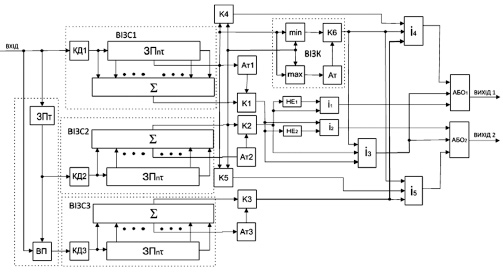
One of the main requirements for radio engineering systems is their ability to withstand high levels of noise in complex, changing and a priori unknown noise environments. Improving the noise immunity of radar systems and the means of radio electronic warfare requires the development of effective noise protection systems with high information content that can operate in the presence of complex, heterogeneous interference. To identify a range-resolution element affected by non-synchronous pulsed noise, an algorithm for detecting pulsed noise has been developed. The algorithm can function effectively in conditions involving an additive mixture of uncorrelated and powerful, discrete in range correlated noise in the presence of restrictions on the dynamic range of the receiving path of the radar system. A structural diagram of a pulsed noise detector has been developed, which additionally includes a block for determining this noise at the output of a single-shot system of over-periodic compensation. To confirm the performance of the developed detector of non-synchronous pulsed interference in the conditions of an additive mixture of uncorrelated and discrete-range correlated Gaussian interference, a simulation model was developed in the Matlab&Simulink software package. The study confirmed the performance of the developed algorithm within the constraints of the dynamic range, and determined the parameters of the additive mixture of pulsed, uncorrelated and correlated interference for which the efficiency of the proposed detector exceeds that of existing detectors. The results obtained can be used to design of coherent-pulsed radar systems for detecting signals from moving targets in complex interference environments.
References
M. I. Skolnik, Radar Handbook, New York, NY, USA: McGraw-Hill, 2008.
Ya. D. Shirman, S. T. Bagdasaryan, and A. S. Malyarenko, Radioelektronnye sistemy. Osnovy postroeniya i teoriya: Spravochnik [Radioelectronic Systems. Basics of Construction and Theory: Handbook], Ya. D. Shirman, Ed. Moscow, Russia: Radiotekhnika, 2007. (in Russian)
P. A. Bakulev, Radiolokatsionnye sistemy [Radar Systems], Moscow, Russia: Radiotekhnika, 2004. (in Russian)
W. L. Melvin, and J. A. Scheer, Eds., Principles of Modern Radar: Advanced Techniques, vol. 2. Edison, NJ, USA: SciTech Publishing; Stevenage, U.K.: IET, 2013. https://doi.org/10.1049/SBRA020E
M. A. Richards, Fundamentals of Radar Signal Processing, 2nd ed., New York, NY, USA: McGraw-Hill Education, 2014.
P. S. Diao, T. Alves, B. Poussot, and S. Azarian, “A review of radar detection fundamentals,” IEEE Aerospace and Electronic Systems Magazine, vol. 39, no. 9, pp. 4–24, Sept. 2024. https://doi.org/10.1109/MAES.2022.3177395.
Д. И. Леховицкий, В. П. Рябуха, А. В. Семеняка, Д. В. Атаманский, and Е. А. Катюшин, “Защита когерентно-импульсных РЛС от комбинированных помех. 1. Разновидности систем ПВОС и их предельные возможности” [Protection of Coherent-Pulse Radars from Combined Interference. Part 1: Types of PVOS Systems and Their Limitations], Известия высших учебных заведений. Радиоэлектроника, vol. 62, no. 7, pp. 380–412, Jul. 16, 2019. https://doi.org/10.20535/S002134701907001X. (in Russian)
D. I. Popov, “Optymizatsiya system vyyavlennya signaliv na foni pasyvnykh pomekh” [Optimization of Signal Detection Systems Against Passive Interference], Visnyk NTUU “KPI”. Radiotekhnika, radioaparatobuduvannya, no. 68, pp. 33–37, 2017. Available: https://ela.kpi.ua/handle/123456789/22840 (in Ukrainian)
Z. Zhou, G. Wei, X. Liu et al., “Noise and Gaussian clutter background descending dimensional subspace signal detector,” in Proc. IEEE SENSORS, Vienna, Austria, 2023, pp. 1–4. https://doi.org/10.1109/SENSORS56945.2023.10324948.
B. Dulek, “On GLRT-based detection of one-sided composite signal in unimodal noise,” IEEE Transactions on Aerospace and Electronic Systems, vol. 59, no. 1, pp. 695–700, 2023. https://doi.org/10.1109/TAES.2022.3188595.
C. Chen, W. Xu, Y. Pan et al., “A nonparametric approach to signal detection in non-Gaussian noise,” IEEE Signal Processing Letters, vol. 29, pp. 503–507, 2022. https://doi.org/10.1109/LSP.2022.3143031.
V. G. Repin, and G. P. Tartakovskiy, Statisticheskiy sintez pri apriornoy neopredelennosti i adaptatsiya informatsionnykh sistem [Statistical Synthesis Under A Priori Uncertainty and Adaptation of Information Systems]. Moscow, Russia: Sovetskoye radio, 1977. (in Russian)
Yu. I. Abramovich, and A. Yu. Gorokhov, “K otsenke skorosti skhodimosti adaptivnykh filtrov kompensatsii pomekh s persimmetricheskoy korrelyatsionnoy matritsey” [On the Convergence Rate of Adaptive Filters for Interference Compensation with Persymmetric Correlation Matrix], Radiotekhnika i elektronika, vol. 38, no. 1, pp. 101–111, 1993. (in Russian)
P. Ye. Baranov, I. V. Tsevukh, and D. Ye. Davydov, “Algoritm poocheerednoy kompensatsii riznoridnykh pereshkod,” [Sequential Compensation Algorithm for Heterogeneous Interference], in Proc. of Odessa Polytechnic University, no. 1(21), pp. 1–3, 2004. [Online]. Available: https://pratsi.op.edu.ua/index.php/pratsi/issue/archive
I. V. Tsevukh, and D. O. Sinyakov, “Coherent–noncoherent processing algorithm for radio signals under complex interference,” in Proc. 18th ISPC “Modern information and electronic technologies”, Odesa, Ukraine, 2019, pp. 30–31. [Online]. Available: https://old.tkea.com.ua/siet/archive/2019/10.pdf (in Russian)
I. V. Tsevukh, A. A. Sakovich, and L. V. Bezrukov, “Impulse interference detector against additive mixture of uncorrelated and range-discrete correlated gaussian noise,” in Proc. 20th ISPC “Modern information and electronic technologies”, Odesa, Ukraine, 2021, pp. 11–12. Available: https://old.tkea.com.ua/siet/archive/2021/11-13.pdf (in Russian)
I. V. Tsevukh, A. A. Sakovich, and O. S. Karpenko, “Pulse noise detection algorithm for moving target selection systems,” in Proc. 21st ISPC “Modern information and electronic technologies”, Odesa, Ukraine, 2022, pp. 14–15. Available: https://old.tkea.com.ua/siet/archive/2022/14-15.pdf (in Ukrainian)
Copyright (c) 2025 Igor Tsevukh, Anastasia Sakovich

This work is licensed under a Creative Commons Attribution 4.0 International License.