
Pulse method for determining the current state of health of an electrochemical energy storage device
Abstract
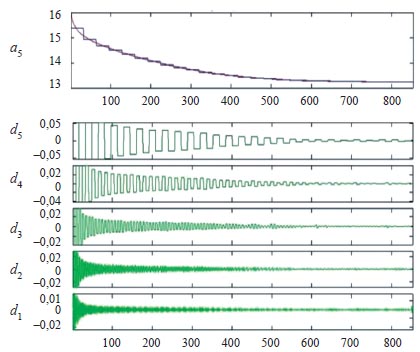
A single-pulse galvanostatic method for rapid determination of the current State of Health (SOH) of electrochemical energy storage devices in dynamic operating modes has been developed and experimentally validated. The proposed method enables SOH assessment without interrupting normal load operation. It relies on the Haar wavelet transform to process the response signal of the energy storage device to a short-term test pulse. Considering the specific profile of the response signal, which reflects multi-stage electrochemical kinetics and is described by slowly changing functions, applying the Haar wavelet transform yields a real-time time-frequency representation of the electrochemical process. Processing the depolarization curve of the response signal following the test pulse via the Haar wavelet transform restricts the area under the voltage curve, which correlates directly with the utilization factor of active materials. Thus, the derived wavelet parameters serve as informative indicators for evaluating the current SOH within a specified time window of the depolarization voltage curve. Experimental results reveal an irreversible, gradual decline in SOH over operational time driven by degradation processes, with the degradation rate accelerating in the later stages of service life. This behavior highlights the complex, dynamic, and non-linear nature of degradation in electrochemical energy storage systems. Unlike existing diagnostic techniques, the developed single-pulse galvanostatic method eliminates the need to disconnect the energy storage unit from the load, allowing real-time SOH monitoring under actual operating conditions.
References
J. Tian, R. Xiong, W. Shen, and J. Lu, “Data-driven battery degradation prediction: Forecasting voltage-capacity curves using one-cycle data,” EcoMat, vol. 4, no. 5, art. e12213, 2022. https://doi.org/10.1002/eom2.12213.
N. Noura, L. Boulon, and S. Jemeї, “A review of battery state of health estimation methods: Hybrid electric vehicle challenges,” World Electr. Veh. J., vol. 11, no. 4, art. 66, 2020. https://doi.org/10.3390/wevj11040066.
L. Yao, S. Xu, A. Tang, F. Zhou, and Y. Kou, “A review of lithium-ion battery state of health estimation and prediction methods,” World Electr. Veh. J., vol. 12, no. 3, art. 113, 2021. https://doi.org/10.3390/wevj12030113.
M. Elmahallawy, T. Elfouly, A. Alouani, and A. M. Massoud, “A comprehensive review of lithium-ion batteries modeling, and state of health and remaining useful lifetime prediction,” IEEE Access, vol. 10, pp. 119040–119070, 2022. https://doi.org/10.1109/ACCESS.2022.3221137.
Z. Wang, G. Feng, D. Zhen, F. Gu, and A. Ball, “A review on online state of charge and state of health estimation for lithium-ion batteries in electric vehicles,” Energy Rep., vol. 7, pp. 5141–5161, 2021. https://doi.org/10.1016/j.egyr.2021.08.113.
E. Meissner and G. Richter, “Battery monitoring and electrical energy management: Precondition for future vehicle electric power systems,” J. Power Sources, vol. 116, no. 1–2, pp. 79–98, 2003. https://doi.org/10.1016/S0378-7753(02)00713-9.
M. Ye, M. Wei, Q. Wang, G. Ye, and J. Wu, “State of health estimation for lithium-ion batteries based on incremental capacity analysis under slight overcharge voltage,” Front. Energy Res., vol. 10, art. 1001505, 2022. https://doi.org/10.3389/fenrg.2022.1001505.
Z. Wang et al., “A review on rapid state of health estimation of lithium-ion batteries in electric vehicles,” Sustain. Energy Technol. Assess., vol. 60, art. 103457, 2023. https://doi.org/10.1016/j.seta.2023.103457.
A. Nickol et al., “GITT analysis of lithium insertion cathodes for determining the lithium diffusion coefficient at low temperature: Challenges and pitfalls,” J. Electrochem. Soc., vol. 167, no. 9, art. 090546, 2020. https://doi.org/10.1149/1945-7111/ab9404.
Y.-C. Chien, H. Liu, A. S. Menon, and M. A. Lacey, “A fast alternative to the galvanostatic intermittent titration technique,” Nat. Commun., vol. 14, no. 1, art. 7300, 2023. https://doi.org/10.1038/s41467-023-43110-6.
F. von Bülow, F. Heinrich, and W. A. Paxton, “The future of battery data and the state of health of lithium-ion batteries in automotive applications,” Commun. Eng., vol. 3, no. 1, art. 173, 2024. https://doi.org/10.1038/s44172-024-00299-w.
S. Plaksin, M. Zhitnik, R. Levchenko, and S. Ostapovska, “Pulse technique of in-operation control and management of energy storage charging process (in Ukrainian),” Technol. Des. Electron. Equip., no. 1–3, pp. 22–30, 2022. https://doi.org/10.15222/TKEA2022.1-3.22.
Yu. Yamnenko, V. Tielieha, and K. Niemchinova, “The use of Haar and OB wavelets in the signals analysis (in Ukrainian),” Electron. Commun., vol. 22, no. 4, pp. 51–58, 2017. https://doi.org/10.20535/2312-1807.2017.22.4.105272.
S. Plaksin, M. Zhitnik, R. Levchenko et al., “Method of processing the electrochemical energy storage response signal for operational control of its energy state (in Ukrainian),” in Proc. 24th Int. Sci.-Pract. Conf. "Modern Information and Electronic Technologies", Odesa, Ukraine, 2023, pp. 41–42. [Online]. Available: https://old.tkea.com.ua/siet/archive/2023/41.pdf
S. V. Plaksin, N. Ye. Zhitnik, and O. I. Shyrman, “Experimental stand for automated monitoring of chemical power sources status by pulse method (in Russian),” Min. Electromech. Autom., no. 89, pp. 48–64, 2012. [Online]. Available: https://www.researchgate.net/publication/338494362_Research_the_advantages_and_disadvantages_of_monorail_transport/fulltext/696b5e0ac454e61a7f5a39da/Research-the-advantages-and-disadvantages-of-monorail-transport.pdf
Copyright (c) 2026 Serhii Plaksin, Mykola Zhitnik, Ruslana Levchenko, Svitlana Ostapovska, Іryna Тymchenko

This work is licensed under a Creative Commons Attribution 4.0 International License.