
Hardware software true random number generator based on a semiconductor photodiode array and logical combinations of cellular automata
Abstract
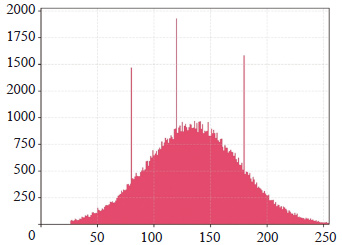
Primary binary sequences obtained directly from semiconductor photodiode arrays of standard CMOS webcams exhibit significant non-uniform frequency distributions and high inter-frame correlation. Experimental measurements reveal critical defects, including anomalous byte gaps in the [0...25] range and a 30% correlation in darkness. Primary binary sequences obtained directly from semiconductor photodiode arrays of standard CMOS webcams exhibit significant non-uniform frequency distributions and high inter-frame correlation. Experimental measurements reveal critical defects, including anomalous byte gaps in the [0...25] range and a 30% correlation in darkness. The primary entropy source is the stochastic photocurrent of the array elements, captured at 25 frames per second and transformed into discrete numbers via analog-to-digital conversion. Local statistical correlations are eliminated using post-processing based on logical combinations of one-dimensional cellular automata. The developed algorithm combines chaotic rule-switching and a multi-component XOR-MIX combination of equivalent primitives.. For high computational efficiency, a lightweight algorithm for adaptive control of evolution iterations based on express root-mean-square deviation control is introduced. The low complexity of bitwise Boolean operations enables real-time data processing on personal computers and embedded microcontrollers. Experimental results show that the developed algorithm provides a real-time generation speed of 47.8 Mbps, with an additional CPU load of only 0.3% and a frame latency of less than 0.1 ms. The normalized stream completely eliminates inherent hardware defects, successfully passing all 15 NIST STS test groups with a stable proportion of over 96%, confirming the cryptographic strength of the method and its high suitability for modern information security applications.
References
F. Martinez, “Attacks on pseudo random number generators hiding a linear structure,” in Topics in Cryptology – CT-RSA 2022, 2022, pp. 97–119. https://doi.org/10.1007/978-3-030-95312-6_5.
R. L. Diachuk, K. M. Dmytrashchuk, A. Mazurets, H. V. Prokhorov, and S. V. Yanushevskyi, "Photosensitive matrix as a source of entropy," in Proceedings of SPIE, vol. 13813, 2025, Art. no. 138132C. https://doi.org/10.1117/12.3092587.
D. Hanzhelo and G. Prokhorov, “Investigation of a Numerical Random Sequence Obtained from a Webcam (in Ukrainian),” Herald of Khmelnytskyi National University. Technical Sciences, no. 2 (333), pp. 120–124, 2024. https://doi.org/10.31891/2307-5732-2024-333-2-18.
L. Crocetti, P. Nannipieri, S. Di Matteo, L. Fanucci, and S. Saponara, “Review of Methodologies and Metrics for Assessing the Quality of Random Number Generators,” Electronics, vol. 12, no. 3, p. 723, Jan. 2023. https://doi.org/10.3390/electronics12030723.
Recommendation for the Entropy Sources Used for Random Bit Generation, National Institute of Standards and Technology, Gaithersburg, MD, USA, Tech. Rep. NIST SP 800-90B, 2018. https://doi.org/10.6028/NIST.SP.800-90B.
S. Wolfram, “Random sequence generation by cellular automata,” Advances in Applied Mathematics, vol. 7, no. 2, pp. 123–164, Jun. 1986. https://doi.org/10.1016/0196-8858(86)90028-X.
T. Toffoli and N. Margolus, Cellular Automata Machines: A New Environment for Modeling. Cambridge, MA, USA: MIT Press, 1987.
J. L. Hennessy and D. A. Patterson, Computer Architecture: A Quantitative Approach, 6th ed. Cambridge, MA, USA: Morgan Kaufmann, 2017.
S. M. Sze and K. K. Ng, Physics of Semiconductor Devices, 3rd ed. Hoboken, NJ, USA: John Wiley & Sons, 2006. https://doi.org/10.1002/0470068329.
S. Donati, Photodetectors: Devices, Circuits, and Applications. Upper Saddle River, NJ, USA: Prentice Hall PTR, 2000.
J. G. Proakis and D. G. Manolakis, Digital Signal Processing: Principles, Algorithms, and Applications, 4th ed. Upper Saddle River, NJ, USA: Pearson Prentice Hall, 2007.
A. Papoulis and S. U. Pillai, Probability, Random Variables, and Stochastic Processes, 4th ed. New York, NY, USA: McGraw-Hill, 2002.
H. Prokhorov, M. Hanzhelo, R. Diachuk, and S. Yanushevskyi, “Investigation of statistical characteristics of random number sequences generated by a webcam using cellular automata functionality and NIST patterns,” Security of Infocommunication Systems and Internet of Things, vol. 3, no. 1, p. 01007, 2025. https://doi.org/10.31861/sisiot2025.1.01007.
S. Wolfram, “Statistical mechanics of cellular automata,” Reviews of Modern Physics, vol. 55, no. 3, pp. 601–644, Jul. 1983. https://doi.org/10.1103/RevModPhys.55.601.
S. Wolfram, A New Kind of Science. Champaign, IL, USA: Wolfram Media, 2002.
P. Chaudhuri, D. R. Chowdhury, S. Nandi, and S. Chattopadhyay, Additive Cellular Automata: Theory and Applications, vol. 1. Los Alamitos, CA, USA: IEEE Computer Society Press, 1997. https://doi.org/10.1109/9780470544150.
Copyright (c) 2026 Serhii Yanushevskyi, Yuriy Dobrovolsky

This work is licensed under a Creative Commons Attribution 4.0 International License.